
Existentialism

Three Levels of Perception: How to become a Zen-master?

Do you remember how we first read books? Those hard-bound things of wonder, with fair, blonde princesses and square-chested knights who would slay dragons and breathe life into the damsel with a kiss… Do you remember Amar Chitra Katha, and the legends of kings and demigods? And then Enid Blyton and her Pixie folks, and later still, Harry Potter, Frodo Baggins, Hercule Poirot…

LEVEL ONE

I don’t know about you, but I read them the same way a devout would read the Bible or the Quran: as gospel. It was written; therefore, it had to be true. This is the first level of perception. When confronted with an experience, we begin by reacting to it, with the body, mind or some combination of the two.

In the first level, the experience itself is flawless. The book is comprehensive, the movie is complete, and the person you talk to is perfect. At this level, we are easily influenced by the permanence and immutability of the stimulus. When our parents said something to us, it had to be correct; it had to be good advice. When a history textbook said that Shivaji was good and Aurangzeb was bad, that had to be correct as well.

LEVEL TWO

Beyond this basic understanding of the world, we begin to question the experience itself. Maybe the book was flawed, or the movie had terrible plot-holes… Perhaps, the person giving us advice is as confused as us.

At this level of understanding, we begin punching holes into theories, books, people and everything that isn’t the Self. We realize that textbooks are flawed because of their own skewed viewpoints, we understand that people have their own vested interests, and that movie-scripts are often written by idiots. At this level, we begin trusting our own previous experiences and the cumulative derived wisdom from those.

We pitch our opinions against those of another. “I think that the eagle could have flown to Mordor and dropped the ring into the fires of Mount Doom”. “I think that Genesis is a bad idea, because I believe in the Big Bang, in evolution, and in scientifically proven concepts”. “I think what you did was really shitty”. Our teenage and early twenties are often about this level of understanding.

LEVEL THREE

After we have spent enough energy fighting with the world, we wonder why we perceive the world in a particular way. What are these lenses through which we observe the world? How do we build our own personal rules?

With a third-person-insight into the prevailing conditions of the mind, we dissect not only why we act the way we act, but also why others act the way they do. In books, movies and works of art, we understand why we perceive a plot-hole where others (including the writer) possibly do not.

It is at this level that I think we are truly incapable of intense hatred or passion. If it can be explained, one can do away with a primal emotional reaction. We begin to see the code that governs this dysfunctional world, and keeps it stuck together in this precarious way.

At this stage, we are far less susceptible to intense life-changing moments. But we become Zen-masters, who can control the flow of water and the motion of the Moon. At this point of balance and peace, the will has a real shot at controlling our own actions.

Note: These levels of understanding are infinite: each subsequent level offers a unique, defining insight into the machinations of the world.

"What Did You Eat Today?"

“Hello,” said Ma, in her cheerful evening voice. It was 8.30 p.m. She was probably having dinner.

“Hi,” I said. “What are you up to?”

“I’m watching NDTV Good Times,” she said. I zoned out. There was talk about beaches, food or something that didn’t interest me. My television – which was a mute, stale discussion about rising communalism – was more interesting. I grunted to keep myself in the conversation.

“What did you eat?” she asked.

“Rotis, rice, raita, some paneer thing…” I said. I didn’t ask what she was eating; how did it matter anyway? I replied with the same words every time she asked me. And she asked me every day, sometimes twice a day.

“I visited Radha aunty today,” she said. I asked her how I was related to the lady. Ma said that she was my aunt in some convoluted way. I’m sure I’ve asked her the question before. I’m sure I’ll ask her again. The conversation went on for two more minutes. She asked, I answered. Then she said goodnight. I hung up.

“You talk to your parents every day?” said the voice from across the room.

“Worse,” I said. “Ma calls once. Dad calls once. At least. Sometimes, I talk thrice a day.”

“Ouch,” she said. She played with her phone. “What do you guys talk about?” she asked me.

“The usual. What we ate, what we did, who we met, are we going out, when are we coming home next, what’s on the news, how Modi’s Twitter profile is so active…”

She grinned. “I don’t know why parents love making such small conversation. I simply refuse to discuss such things.”

“What do you say?” I asked her.

“I dunno…” She got back to texting whoever she was texting. “We… have this understanding.”

“I just don’t pick up those calls,” said Joint, plonking himself in front of the tele. “See?” he said. Dad Calling. The phone vibrated for forty-five seconds and then fell silent.

“Doesn’t that feel horrible?” I asked him.

“They understand man. If you tell them, they’ll understand you’ve got stuff to do. Why would you want to have shallow talks with them?”

“We have shallow talks with everyone, no?” I asked, turning towards her.

They threw me blank stares, almost as if they expected me to erupt with laughter and tell them I had them for a moment. They shook their heads – no.

“If your girlfriend wants to tell you what she is learning to cook, what will you do? Hang up on her?”

“It’s slightly harder there,” he said. “You need to feign attention. Continue with your stuff.”

“What do you actually like talking about then? What is important in this world?”

“Physics, genetic science, economics…”

“Why… Philosophy, mobile technology, politics, energy!”

“They make our world man… These are pointless trivialities we bother ourselves with. They just expand to occupy our time.” He then turned up the volume of the television, and we returned to our own mobile devices.

My eyelids were closing. I should go to the bedroom, I thought. “I’m gonna crash. Good night,” I said.

“Good night.”

“’Night…”

The irony of the situation rushed into my head; as I walked to my room, with my laptop cradled in my arms, my eyelids stopped feeling heavy. I smiled and continued my walk into the bedroom.

We drown ourselves in innocent conversations without life-changing implications all the time. We time our lives with clocks, we go to the gym, we eat dinner together, we build routines, we laugh at stupid things, we kiss and forget about it, we read books, we wish each other goodnight, we ask our loved ones what they had for dinner.

It is only necessary in this overpowering void. In the beginning, there was only emptiness. A human being was cast into this vacuum and told, “Make what you want of it!”

Voids can be intimidating. Imagine you are in space. There is nothing around you. You are floating; there is nothing to anchor you. Your feet are useless. You are spinning, faster and faster. You cannot control it. There is nothing to grab, there is no air, no sound, nothing. You are just a mass of flesh, alone without meaning, without purpose, without anything to hold on to.

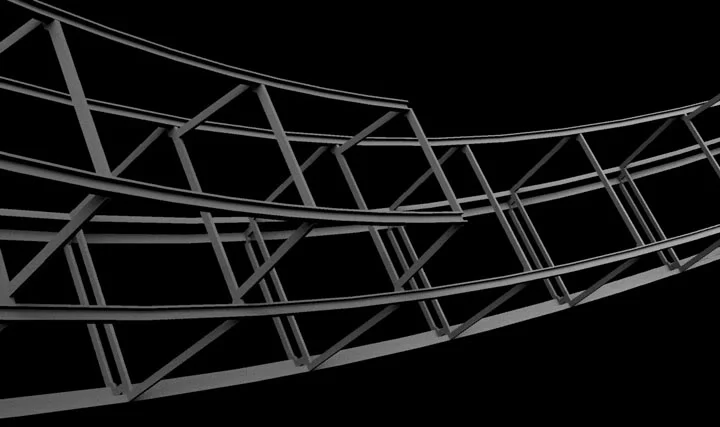
So humans began developing society, and complex systems to act as girders and beams. We developed chemistry and math, mythology and music, wars and painting. These can be seen as a gigantic framework protruding into space, attempting to spread into this supermassive black-hole. But that is as much as they ever will be – a framework.

In order to make them useful – in order to endure this void and perhaps live in it – humans must find ways to use this skeleton made of science, values, art and all cumulative knowledge to access the world. While we access the universe, we populate this minimal framework with habits, fleeting actions, whimsical decisions, words and thoughts that mean nothing. These help us fill the world and make it bearable.

The worlds of science and music and fantasy exist only so that you can carry on with your meaningless telephone conversations. Remember that. Pick up that phone-call. Talk.

"Good night!"

A New Year Is Upon Us

If space and time were interchangeable, we'd be constantly leaving worlds behind.

Our hearts are stout vessels, forged out of tissue stronger than tempered steel. How else can they remain undaunted in the face of savage change? How else can they desire transformation and simultaneously abhor it?

A new year is upon us, to lift us like leaves, like petals, like clouds. And to crush us like withering rocks under iron soles.

Do I take time and space by the scruff of their necks, force them to do my bidding and perish gloriously in a blinding white light? Do I sit in my balcony and watch the whims of the Universe turn beggars to kings and kings to beggars? Do I submit myself to the blessings and the onslaughts?

Am I a subject of this world or an object for another's taking? Or are these different ways to view the same reality? Or are these just lies!

Resolutions are for cowards. I will confront the new year, armed with nothing but belief. I will not wilt under the brutalities of  adult society. I will learn from the past but I shan't cling on to wisdom. I will retain the heart of a child.

I will look to my compass for guidance, for it errs not in this world of mirrors. I will draw lines in this grey battlefield of meanings, and I will have the courage not to cross strokes of peril. I will accept paradoxes instead of bartering goods.

In a way I never have before, just like I promise myself year after year, I will prevail.

"How can this be any different from what we have already seen?"
"It's a trick. They always change everything when you're looking away."