
The Great Indian LSD Trip

700MB, 96 minutes. The picture quality, from the 80’s, made me wonder if Kamal Swaroop intended it to be this way. Or if I had just downloaded a poor video.
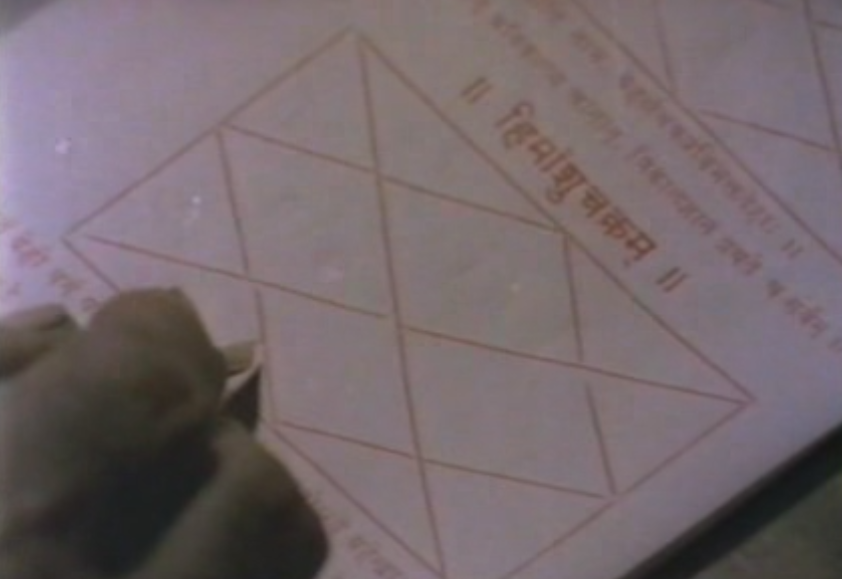
A hand hangs over the Himanshuchakram, slowly moving the dry nib over its surface as the narrator explains the origins of the name ‘Om’. Gayatri dreams of a life of riding her bicycle, which for her is no different from freedom. Om is in his Science class while a frog expands and becomes ‘Rana Tigrina’. There are familiar noises which I cannot place, and half sentences that I can almost understand. The story jumps forth and backwards again, spinning, sliding, slowing…

The calm landscapes are a source of irony in this tumultuous tale which doesn’t try to be anything. It is rightly dubbed the great Indian LSD trip, for it is a spectacle, a series of sounds and disconnected meanings, leaving you with a strange feeling that you know what it is all about. But you can’t say it out aloud, not even to yourself.

I suppose there are themes of confusion, teenage angst, sexuality, superstition and death. Any or all of these could exist simply in my mind, as Om-Dar-Ba-Dar is simply a framework that you fill with your own thoughts and feelings. In one scene Om’s nostrils are flaring; he can’t continue studying. When asked why, he says that his nose comes in the way of his vision. “Jab main padhta hun, to naak akshar kha jaati hai.” As a remedy, he is given dark-goggles and told that they will help keep his eyes within the frame. I think the movie is the frame within which we are allowed to move.

This is a movie about diamonds within frogs, crackers which become bombs and a boy who earns a living by holding his breath. I will learn more from this dream the next time I watch it.
Bullet-holes In My Windshield

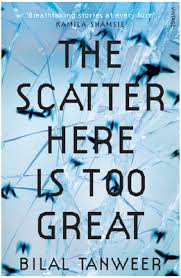
A bullet-hole in a windshield, with far-reaching cracks spreading out as a chaotic web, dividing the continuous sheet of glass into discrete fragments. Fragmented stories of a violent city come together like a jagged piece of glass; in the end, the picture is almost complete.

Dark themes stand in stark contrast to the tender lives of three generations of Pakistanis. The English is subcontinental, and the work is beautiful is both form and function. But as it transforms into an immersive experience, The Scatter Here Is Too Great bites off more than it can chew.

Scatters are conventionally unstructured; Bilal Tanweer creates one such scatter here. He zigzags through themes of love, belief and violence, and drowns us in a confusing maze of ideas. A longer work that would communicate these thoughts more easily would come at the expense of Tanweer's pace.

This book, however, overcomes these mild drawbacks and presents itself with a powerful, integral soul. I want to visit Karachi now.

Sweet Sickness, Pure Genius

“The voice sings: Some of these days, you’ll miss me honey.

Somebody must have scratched the record at that spot because it makes a peculiar noise. And there is something that wrings the heart: it is that the melody is absolutely untouched by this little stuttering of the needle in the record. It is so far away - so far behind. I understand that too: the record is getting scratched and worn, the singer may be dead; I am myself going to leave, I am going to catch my train. But behind the existence which falls from one present to the next, without a past, without a future, behind these sounds which decompose from day to day, peels away and slips into death, the melody stays the same, young and firm, like a pitiless witness.”
— "Nausea", Jean-Paul Sartre

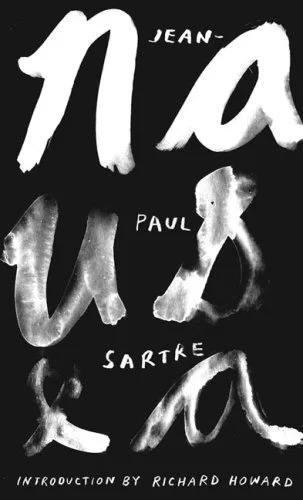
The back-cover of this book has the words "A young man's tour de force" written in bold black font, in a grey background, almost vain and gaudy, saved only by the fact that it is in black and not in gold. It is an understatement.

Sartre's work leaves me with a clear idea of the void that we live in - a world with spaces and objects, and nothing. We try to fill it will meaning, we try to find connections, we try pursuing grand themes, we love, hate, cry, laugh and shout. Nausea is about Antoine Roquetin - a man who could be you or me - who feels helpless about his existence. He realizes he must go on, and as he plunges into the depths of these thoughts, he associates meanings and feelings with his interactions with objects.

 There were moments when I loathed the work and wished it wasn't written, because it was true. But such a magical description of youth and existence in this world must be real. It must be tangible. Like the objects of Roquetin's nausea.

If this book doesn't make you feel miserable, then you are impervious and your delusion is complete. It is a roller-coaster going down, down, down...