
Standstill

Ramu shifted uncomfortably in his seat, jamming the horn two more times, drowning Honey Singh’s melody within the car. Slanting rays of the sun scattered through the dust and smoke before falling on the hanging form of Hanuman carrying the mighty Sanjeevani. The monkey God swung violently every time Ramu stepped on the accelerator. The car lurched forward through tiny capillaries which the driver spotted in the clogged road.

In the back seat sat a man who was referred to only as Sharma sa'ab within the car’s confines. Ramu could see in the rear-view mirror above the monkey God that sa'ab was busy with his computer on his lap and his phone sandwiched between his left ear and shoulder. He was in a hurry; Ramu had fifteen minutes to make sure the boss got to his meeting on time.

“Lower the volume,” was the command. A knob was turned. The horn blared again through the static traffic.

“Be’nchod!” swore Ramu quietly. What would normally take him twenty minutes was now taking him over half of an hour. He felt the cards in his pocket, and thought about the game he had won the previous afternoon. The memory calmed him.

He slid the window down halfway, leaned towards it and spoke over the noise of the expressway, “Problem kya?”

“Pata nahin (I don't know)!” said the rickshaw-wallah whose vehicle stood alongside his own.

A motorist managed to squeeze in between Ramu’s right-side mirror and the auto-rickshaw. “There’s an accident in front of us,” he said, staring ahead through the cracks between trucks and SUVs. He nonchalantly closed Ramu’s rear-view mirror and passed them, expertly entering the gap between the bus and the divider.

Sharma sa'ab saw the motorist’s action and momentarily stopped his work to swear at him. “They are idiots, sir,” said Ramu in agreement. “They are from villages. They don’t know better.”

Sharma sa'ab stared ahead at the stubborn vehicles in front of him, and eyes widening, looked at the time on his laptop screen. “Jaldi!”

“Yes sir,” said Ramu, hitting the horn again forcing the traffic to move another centimetre. “Bloody fellows chose to have an accident today.”

“Yes, my luck is horrible,” said Sharma. “It’s always like this.”

Ramu looked at the dashboard-clock, then at Hanumanji and then at the red tail-lamps in front of him. Suddenly a gap opened up in the corner and Ramu, with all his experience, was the first to react. Driving is always a series of challenges and achievements: you overtake a supercilious fool, you give way to an old lady, you joust with a young man your age…

Ramu stepped on the pedal and turned the wheel ever so slightly, thus throwing the car brilliantly into the gap on the left hand side, stealing the rightful space of the vehicle alongside him. He glided between the remaining vehicles almost as if he was cutting through the jam with a hot knife. Horns blared behind him, and this satisfied both driver and boss greatly.

“Bas five minutes, Sharma sa'ab,” said Ramu as he drove out of the jam. The man in the back seat dialled a number. The car emerged from the cluster of vehicles, passing the sedan with a shattered windscreen - the culprit. As Ramu sped through shards of glass scattered across the asphalt like the brilliant stars of the night, Sharma saheb spoke on the phone – “I’ll be there in five. There was an accident in the middle of the expressway. One car has brought the city to a standstill.”

The driver adjusted his rear-view and kissed the locket around his neck as he peered into the mirror: police, stretchers, strangers and a boy whose world had come to a standstill.
Corner Man

His chair was in the corner, almost hidden, as it lay in one of those places the dull tubelight simply wouldn't reach. He wore a cream shirt, or perhaps it was white - only rendered cream by the lazy flourescent bulb. His khaki pants were clearly khaki; any idiot would tell you that much. He wore open-ended slippers, with a ring which went around his big toe. A lazy smile completed his outfit, as he sat comfortably on the chair in the corner, almost hidden from view.

I must confess that I am perhaps fooled by youthful perspectives and tricks of the mind. Maybe the light was bright, maybe I was too busy marching up and down the corridor to notice people who sat in the corner. Nevertheless, my reality allows me to tell you this - be it truth or be it lie.

As the years passed, my chest grew wider, getting itself a shape I'd often admire at length in front of a mirror, but the man still sat in the corner. My shirts then began to tighten around the belly rather than at the top, and the man still sat there. I wore ties now, and he was in his khaki trousers. He wore a whitish shirt though, but that was only because I had the bulb replaced. His heels were cracked and his slippers were old. It is strange I noticed all this without registering his face.

The meetings then began and my room shifted. I seldom walked the paths I used used to. The doors were made of glass and the air was 12% dryer and 3.5 degrees cooler. I had some weighty fabric over my shoulders, adding value to the opinions of peppered head. I spoke softly now, for there was no need to shout. People now listened to me. I made a lot of money. I polished my fine leather shoes.

A few years later, I went back to the junior office building on a routine inspection. I met the old folks, everyone was greyer, wiser and slightly more lost. The boys now had families, some were even grandparents. They had houses, phones, planned holidays and debts. They had dreams, great dreams, almost as brilliant as the ones they used to have.

As I began to leave, I spotted a smile. I turned around to identify the culprit. In the corner, on a chair almost hidden, in a place where light didn't truly reach, sat a man - crosslegged. He wore khaki trousers and a cream coloured shirt. The tubelight required to be changed. I noticed that his slippers which were on the floor were the same as the ones I remembered from my youth. The one on the right had a withering toe-ring. It bothered me that this man was smiling, and I wished he would stop. I walked away quietly after shaking hands with the senior folks.

*     *     *     *     *     *     *     *     *     *     *     *     *     *     *     *     *     *     *     *

Today is retirement day. I gave a fabulous speech, after which everyone clapped. The applause went on for two minutes. The memory will go on forever. I received souvenirs and gratitude. I passed on the baton, and they told me that I would be missed along with my vision. There is much left to do even after this: so many dreams still worth conquering. I feel sad about leaving, so I will take another trip around the office.

I am walking down the old corridor again. I will be out soon. I see the man in the corner. He is smiling. This distrubs me. Who is he and why is he sitting there? Why does he wear the same clothes? I walk up to him, breathing heavily. His face still doesn't seem important. But his smile, why does he smile?

I put my face close to his, almost until our noses touch, and I scream - "Why do you smile?"

He doesn't answer. He simply slides his feet into his slippers.

"Why are you here?" I shout. My cheeks feel wet. I don't want anyone to see me this way.

No reply.

"Why? Please. Tell me," I sob.

"Okay, I'll go now," he says. And he leaves.

*     *     *     *     *     *     *     *     *     *     *     *     *     *     *     *     *     *     *     *

Tamil and the Concept of India

Narendra Modi's "maximum Governance, minimum" Government has taken a minor detour, throwing in another troublesome issue into the pot of problems. The directive aimed at maximizing Hindi and minimizing English has Indian bureaucrats scrambling for Hindi dictionaries. Quite predictably, regional leaders seeing red, have issued strong written responses to the Center, causing the Modi-regime to partially recall their broad-spectrum antibiotic.

However, this stirred hornet's nest now smells of Annadurai and Periyar and of a certain Mr. Raghunath Vinayak Dhulekar who famously said - "People who do not know Hindustani have no right to stay in India. People who are present in the House to fashion a constitution for India and do not know Hindustani are not worthy members of this assembly. They had better leave."

The days of Hindustani ended a long time ago when the two-nation theory was practically imposed. The Persian-Arabic influence on Hindustani quickly decayed, quite naturally but with a few political nudges from here and there, until what remained was only Hindi. The fact that the Indian Constitution was written in English irked many in those days, but it stayed that way due to political and administrative vision that remained in an assembly ravaged by nationalistic fervour. Sixty years have passed since those turbulent times and we're back where we began. The same parties which had issues back in the day have troubles in accepting changes which are being imposed on them.

I write this article as a Tamilian and as an Indian, hoping that I don't have to choose between the two or explain which I am more - a Tamilian or an Indian. Since Tamil Nadu has been the most vocal state about its displeasure with these new directives, leading to questions about Tamil Nadu's patriotism and "why does TN have a problem if Andhra Pradesh can accept it?", I will give you a Madrassi's viewpoint and state, in clear terms, where we stand.

But for that, we will need to take a short trip into history.

History and Individuality:

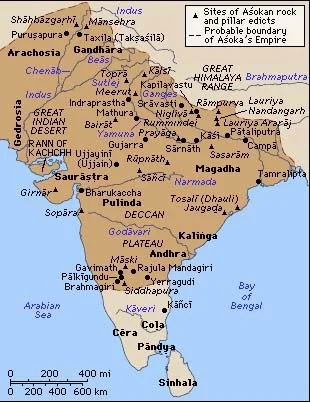
The third century BC was a truly glorious period for the land which is now India, with great emperors such as Chandragupta Maurya and his grandson Ashoka creating some of the greatest land empires ever known to man and subsequently consolidating this powerful territory, ushering in a truly golden age. This (see left) is what the Mauryan empire looked like at its peak.

Ashoka, after relinquishing his arms rather dramatically after the Kalinga war, contributed majorly to the growth of another major Indian religion - Buddhism. The languages of his state, namely Magadhi, Sanskrit and the Prakrits flourished during this period.

At quite the same, the southern end of the Indian peninsula, was divided among three dynasties which were each centuries old already.

"Bindusara (Chandragupta Maurya's son) didn't conquer the friendly Dravidian kingdoms of the Chola, ruled by King Ilamcetcenni, the Pandyas, and Cheras. Apart from these southern states, Kalinga was the only kingdom in India that didn't form a part of Bindusara's empire. It was later conquered by his son, Ashoka."

Over the coming hundreds of years, the northern plains would change hands several times - with the seat of power remaining in Pataliputra and with Sanskrit gaining great prominence. The beginning of the golden Gupta age incidentally coincided with the last of the great Sangam meetings in the Pandyan kingdom.

Subsequently, while the kingdoms in the North fragmented further, the Chola empire also faded around the 4th Century AD, and remained hidden for nearly five centuries. This period marked the ascendancy of the Pallavas and the Pandyas in the southern part of the peninsula.

Even during this time, the cities of Mayiladudurai, Chidambaram, Thanjavur, Thiruchi and Pudukkottai fell under the sway of the fallen empire. Meanwhile the ascendant Pandyas further south extended their influence from their capital - Madurai.

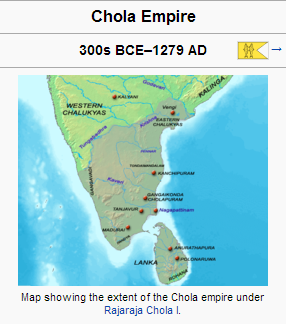
Between 800 AD and the end of the thirteenth century, the Cholas were once again a well-established empire and often the most powerful kingdom of the south. Gangaikonda Cholapuram is, in fact, said to have been built after a successful military campaign all the way to the banks of the Ganges.

Beyond the thirteenth century, the Pandyas still flourished and even reached their peak. It wasn't until the raids by Malik Kafur and the formation of the Madurai Sultanate that this last great empire of South India was finally vanquished. All this after 2000 years at the helm of affairs.


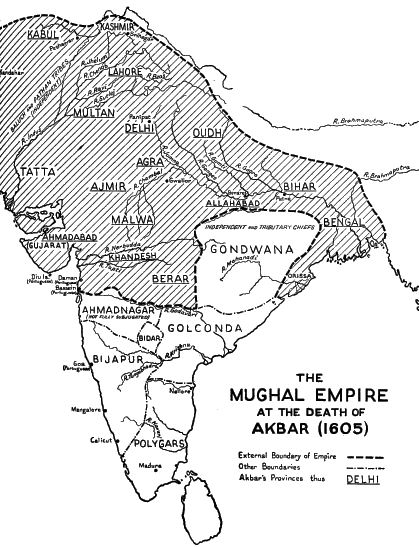
Even after the end of the great empires of the south, India as a land was never fully consolidated. Akbar's great Mughal empire (and Aurangzeb's also) from the 1600s failed to completely absorb 'India' completely.


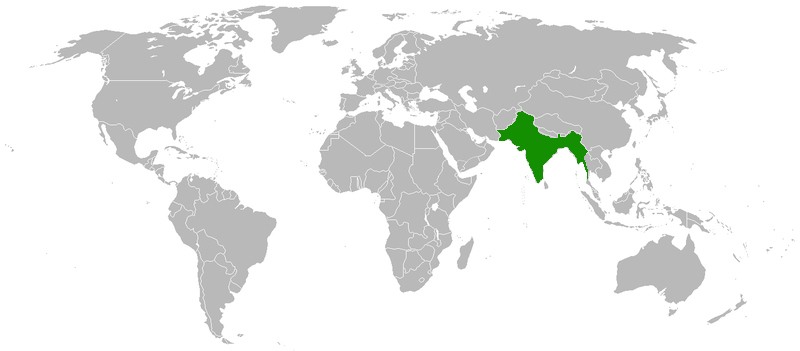
In fact, it wasn't until the British Raj that the map looked like this:

What all these millenia of indigenous rule has created - please note that the separated territory involved is predominantly Tamil Nadu and Kerala - is a strong sense of identity with language, which has been the pole-star in Tamil history.

Hindus, Muslims and Christians live cheek-by-jowl almost everywhere along TN's coastline today. In fact, some of the best assimilation of different communities in a particular area can be seen in the state, where you can easily mistake a dargah's ritual as that of a temple's, or confuse Mariamman with Mother Mary. These are people divided by faith and united by language.

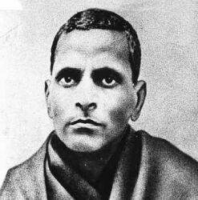
Unlike most Northern communities where people identify most strongly with religion and caste, the divisions down south are on lingual lines. Although I previously removed AP from this picture, one will do well to remember Potti Sriramulu (picture below), who born into the Madras Presidency died as a Telugu martyr.


His death reshaped India's map and gave us states based on language. Interestingly enough, there were debates as to whether Madras was to be part of Andhra Pradesh or Tamil Nadu (with C. Rajagopalachari and Nehru, both favouring to keep it in TN) owing to the large communities of Andhrites as well as Tamilians in the city.

When human beings draw careless boundaries on the map, they reshape the future of civilization. Only a few decades after the formation of AP, we have only a small (but often influential) representation of Telugu-speakers in Chennai today. Similarly, Tirupati - where boards in Tamil were ubiquitous - has been cleansed of the Tamil language and replaced by Telugu. Stronger divides still, happen on the national level, as in the case of India and Pakistan, where now the respective scripts are mutually unintelligible. 

What all this tells us is that language, like any other aspect of civilization, requires patronage and support in order to exist. The invisible hand of market forces can hardly stand up to the real force of political will. In such a scenario, it makes perfect sense to protect a language and preserve heritage. Reactionary steps are only to be expected when the Government of the land tries to propagate one of its languages preferentially, albeit not necessarily at the expense of another. But we are talking about identity here, and there are few things that come with higher stakes.

The Modern Notion of India:

Sometimes, I am perturbed by the fact that restaurants in Delhi have on their boards messages such as:

"Cuisines: Indian, South Indian, Chinese". The definition of 'India' then begins to confuse me. Is South India a sub-set of India (as would seem logical) or is it another part of a vast region, thoroughly separated, united only by national elections?

Even today, I am asked - "Why do your people not speak Hindi? It is the mother tongue of the majority of India!" To clarify things at this point, I speak Hindi and Tamil, although I can write only in the former, much to my chagrin. My parents, brought up in 20th Century India, decided that it was better for me to learn the language spoken by the majority first, before my own mother tongue. While all that is water under the bridge, this only helps me consolidate my point that the people of Tamil Nadu are not opposed to Hindi as a language.

However, we expect our guests to speak in Tamil (or at least feign to learn) when they are visiting us, just the way we learn Hindi when we visit them. To say that Hindi is more Indian than Tamil is, or the even more inane "Hindi is the national language", is a poor line for apatriot to take. I am reminded of a vivid quote made by C. N. Annadurai - "It is claimed that Hindi should be the common language because it is spoken by the majority. Why should we then claim the tiger as our national animal instead of the rat which is so much more numerous? Or the peocock as our national bird when the crow is ubiquitous?"

It must also be noted here that Hindi and English are both, to some extent, foreign languages in the southern tip of the peninsula. The fact that enterprising Malabaris have picked up the languages quickly and become trilingual (I am assuming not all Malabaris can speak Arabic also) is something they should be credited with, and this is not something one can hold against people who haven't become multilingual with such rapidity.

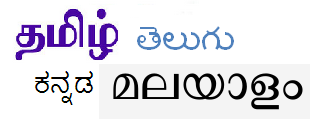
While the question of whether a person from Region C should be encouraged, or perhaps forced, to speak in Hindi is widely debated, the more basic question regarding whether an outsider should be asked to learn the tongue-of-the-land is being left unattended. When I first went to Roorkee (which lies in the state of Uttarakhand), I was appalled to find out that people couldn't match the southern states with their respective languages. In fact, even today, I'm fairly confident that few will be able to tell which language is which from among the following:

So, another thing that the imposition of Hindi by the state does is promote one-upmanship, and let citizens take it for granted that Hindi is more important than any other language in India. In fact, prominent books written in the twenty-first century use those very words - "Hindi is the most important language in the country". Such statements beg the question: "Does Indian-ness have its roots in Hindi?"

Is it wrong for an auto-wallah in TN (who probably doesn't know Hindi) to speak in Tamil to a Hindi-speaker, while it is right for the Prime Minister (who clearly knows English) to converse in Hindi alone with a non-Hindi speaker? Why is the promotion of a state-language any different from the promotion of a state-religion? Why is only one of these considered taboo?

Second Language and The Future:

Because most higher-learning in this world is being transmitted through the medium of English, it will be difficult, if not impossible, to reject the language altogether. Unless the state can magically conjure a similar infrastructure in Hindi, as there exists in English, it will be wrong to ask people of the southern states to choose Hindi over English, as their second language.

For all practical purposes, this would imply that quarter of a billion people become trilingual at least, to ensure a smooth transition. Learning languages isn't an easy task, especially when the languages belong to entirely different families. This is another reason why Gujaratis, Marwadis and even Maharashtrians can understand Hindi more easily than Tamilians. Similar scripts and shared roots are a great advantage while learning new tongues.

Contrary to a popular misconception, Tamil does not have its roots in Sanskrit. The other three languages have different proportions of Tamil and Sanskrit, as they evolved over the millenniums, gradually developing a flavour of their own. Kannada and Telugu especially, have incorporated far more Sanskrit, and are therefore slightly closer to the northern stream of languages.

All this makes it difficult, both in terms of learning and in terms of ideological acceptance, for Hindi to become a widely accepted second-language in the south, especially in Tamil Nadu. It is possible that, over time, there will be organic growth of the language (this is actually highly probable due to the one-sided language transfer within the country) and that is the only acceptable solution.

Until then, we don't need any more link languages. And thank you very much, we're well-integrated into mother India. We certainly don't need anyone to tell us how we can be better Indians.