Tamil

Kabali, The Last Superstar

I haven't watched the movie yet, but a helpful family member - my mama's cousin's daughter-in-law's nephew - sent us a full movie download link on Whatsapp. It works, I checked; but I didn't download the movie, as I've sworn allegiance to Thalaivar and Tamil Cinema.

When Rajini Became Superstar

I wasn't always like this. Like many of my TamBrahm friends, I looked back at the days of Mannan, Thalapathy and Annamalai (or his funnier side in Thillu Mullu), and thought of them as Rajini's glory-years, before he sold out to his Superstar avatar. Although he always lived in the shadow of Kamal Hassan in our minds, that's the closest he had come to being the real king of cinema.

"Amma Enrarazhaikaatha..." from the film Mannan


When Padayappa killed it in the Box Office in '99, Rajini quickly shifted gears and became the South India's biggest and only real superstar. In the next few years, he released Chandramukhi (Bhool Bhulaiya, in Hindi), Sivaji - The Boss, Enthiran... each opening in more theatres globally than its predecessors. Packed with elaborate unbelievable plot-lines and trademark Rajini punch-dialogues (delivered like only Rajini can deliver), and riding on his highly affable personality, Tamil cinema thrust itself on the national stage.

North India watched, not in awe, but clutching its belly in laughter: Rajini stopped bullets, Rajini conquered Mars, Rajini could change the laws of Physics. I remember distinctly how it irritated me when people laughed at Rajinikanth - someone they had never watched in theatres, because of SMS forwards which were not even true. For the first time in my life, I defended this man - not because I admired his acting, but because it threatened my identity. Suddenly, Rajinikanth was part of who I was.

I watched Enthiran alone in the theatre...

The inaccessibility of Tamil cinema outside Tamil Nadu and major metropolitan cities creates a barrier for even the most ardent fans. For a travelling, English-speaking, semi-fan like me, who finds it easier to name Hollywood films than films in Hindi or Tamil, it is almost impossible to follow Kollywood.

Given Rajini's stature, he was one of the few (probably the only) actors whose films were screened in smaller Indian cities up North, at least dubbed in Hindi. During my college days, news about Rajini films became my only connection to Tamil Nadu, to Chennai and my childhood. I made it a point to watch his films, and say nice things about it.

Saying good things about Rajini felt like patting yourself on the back, happy that you'd enjoyed what your childhood friends had enjoyed, wherever they were in the world. You could enter Sathyam cinemas, knowing nothing could go wrong in the next two hours. After all, they did a paal abhishekam outside to ward off evil spirits.

And so I went to watch Enthiran, long after everybody else had, alone, with a Rs. 120 ticket in Sathyam. I've never gone to a theatre alone since, but that day I had an incredible shared-experience with strangers I couldn't see in the cinema hall. *wolf whistles*

The Rajini Effect

While the great Indian emigration, specifically the emigration of Tamils, started a long time ago, it received that massive push in 1991, that changed things as we know. The kind of push that ensures you and your friends will find yourself outside Chennai, probably outside Tamil Nadu, and possibly outside India, a few years after school.

This, however, also ensured that all of us carry a bit of home, and therefore a bit of Rajini, to every corner of the globe. And suddenly, people in Europe, Japan and Houston were mouthing the words - "Naan oru tharava sonna, nooru tharam sonna madhiri".

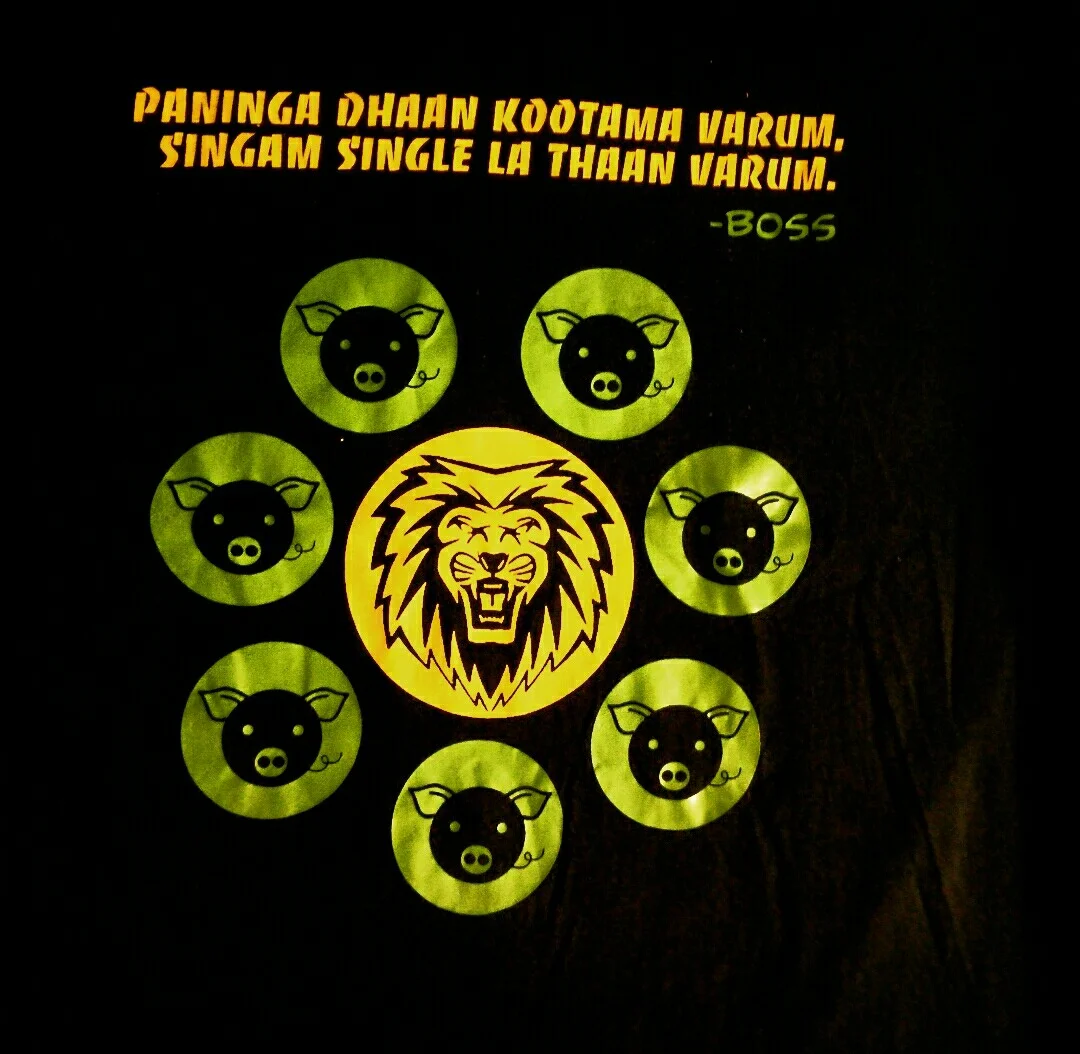
My friend's startup, that designs T-Shirts, came up with designs like this one, that I purchased:
Some things happen once, and only once, and never happen again. Rajinikanth is our last superstar. Rajinikanth - the phenomenon - will end, and there will never be a Rajini again. When will there be another time, when such mass-migration will take niche pop-culture to every corner of the globe?

The reason we all feel connected by Rajini, and can share the Rajini-experience wherever we are, is because we started in an age that wasn't as connected, and grew into the information age carrying our mini-cultures with us. There will never be another Rajini, because the beginning of the Information Age has ended, and we've lived through it already. There will never be another Rajini because our idea of home has forever changed. There will never be another Rajini because we cannot imagine another age where we can share a veg puff at a shady roadside teashop, trying to wear a pair of round -3.50D spectacles Rajini-style.

Rajinikanth, who I never admired in my childhood, is now a part of me. I have the option to watch the full Kabali movie right now, by clicking on a link on Whatsapp. But I won't. Because Kabali is more than a movie, Rajinikanth is more than an actor.

Rajini is an experience. Rajini is a phenomenon. He gives us a collective-identity. It doesn't matter where you are in the world, Rajinikanth will guide you home.
Tamil and the Concept of India

Narendra Modi's "maximum Governance, minimum" Government has taken a minor detour, throwing in another troublesome issue into the pot of problems. The directive aimed at maximizing Hindi and minimizing English has Indian bureaucrats scrambling for Hindi dictionaries. Quite predictably, regional leaders seeing red, have issued strong written responses to the Center, causing the Modi-regime to partially recall their broad-spectrum antibiotic.

However, this stirred hornet's nest now smells of Annadurai and Periyar and of a certain Mr. Raghunath Vinayak Dhulekar who famously said - "People who do not know Hindustani have no right to stay in India. People who are present in the House to fashion a constitution for India and do not know Hindustani are not worthy members of this assembly. They had better leave."

The days of Hindustani ended a long time ago when the two-nation theory was practically imposed. The Persian-Arabic influence on Hindustani quickly decayed, quite naturally but with a few political nudges from here and there, until what remained was only Hindi. The fact that the Indian Constitution was written in English irked many in those days, but it stayed that way due to political and administrative vision that remained in an assembly ravaged by nationalistic fervour. Sixty years have passed since those turbulent times and we're back where we began. The same parties which had issues back in the day have troubles in accepting changes which are being imposed on them.

I write this article as a Tamilian and as an Indian, hoping that I don't have to choose between the two or explain which I am more - a Tamilian or an Indian. Since Tamil Nadu has been the most vocal state about its displeasure with these new directives, leading to questions about Tamil Nadu's patriotism and "why does TN have a problem if Andhra Pradesh can accept it?", I will give you a Madrassi's viewpoint and state, in clear terms, where we stand.

But for that, we will need to take a short trip into history.

History and Individuality:

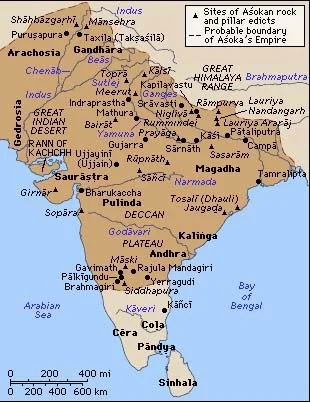
The third century BC was a truly glorious period for the land which is now India, with great emperors such as Chandragupta Maurya and his grandson Ashoka creating some of the greatest land empires ever known to man and subsequently consolidating this powerful territory, ushering in a truly golden age. This (see left) is what the Mauryan empire looked like at its peak.

Ashoka, after relinquishing his arms rather dramatically after the Kalinga war, contributed majorly to the growth of another major Indian religion - Buddhism. The languages of his state, namely Magadhi, Sanskrit and the Prakrits flourished during this period.

At quite the same, the southern end of the Indian peninsula, was divided among three dynasties which were each centuries old already.

"Bindusara (Chandragupta Maurya's son) didn't conquer the friendly Dravidian kingdoms of the Chola, ruled by King Ilamcetcenni, the Pandyas, and Cheras. Apart from these southern states, Kalinga was the only kingdom in India that didn't form a part of Bindusara's empire. It was later conquered by his son, Ashoka."

Over the coming hundreds of years, the northern plains would change hands several times - with the seat of power remaining in Pataliputra and with Sanskrit gaining great prominence. The beginning of the golden Gupta age incidentally coincided with the last of the great Sangam meetings in the Pandyan kingdom.

Subsequently, while the kingdoms in the North fragmented further, the Chola empire also faded around the 4th Century AD, and remained hidden for nearly five centuries. This period marked the ascendancy of the Pallavas and the Pandyas in the southern part of the peninsula.

Even during this time, the cities of Mayiladudurai, Chidambaram, Thanjavur, Thiruchi and Pudukkottai fell under the sway of the fallen empire. Meanwhile the ascendant Pandyas further south extended their influence from their capital - Madurai.

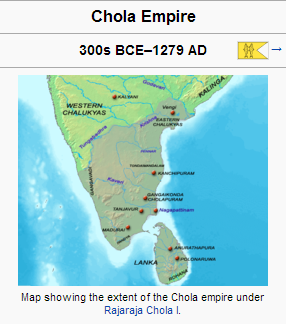
Between 800 AD and the end of the thirteenth century, the Cholas were once again a well-established empire and often the most powerful kingdom of the south. Gangaikonda Cholapuram is, in fact, said to have been built after a successful military campaign all the way to the banks of the Ganges.

Beyond the thirteenth century, the Pandyas still flourished and even reached their peak. It wasn't until the raids by Malik Kafur and the formation of the Madurai Sultanate that this last great empire of South India was finally vanquished. All this after 2000 years at the helm of affairs.


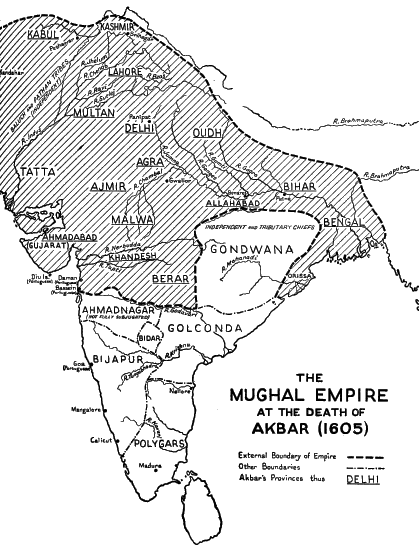
Even after the end of the great empires of the south, India as a land was never fully consolidated. Akbar's great Mughal empire (and Aurangzeb's also) from the 1600s failed to completely absorb 'India' completely.


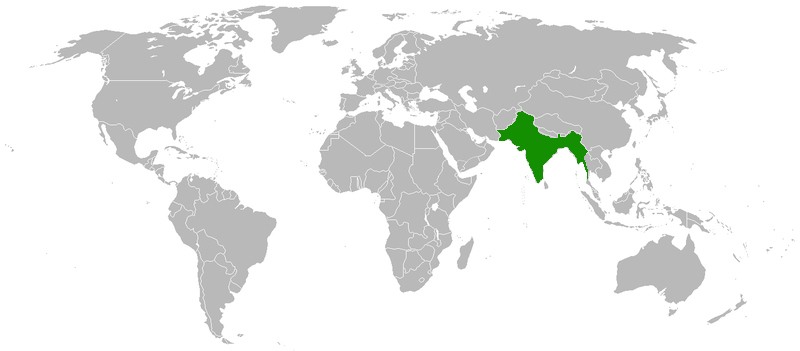
In fact, it wasn't until the British Raj that the map looked like this:

What all these millenia of indigenous rule has created - please note that the separated territory involved is predominantly Tamil Nadu and Kerala - is a strong sense of identity with language, which has been the pole-star in Tamil history.

Hindus, Muslims and Christians live cheek-by-jowl almost everywhere along TN's coastline today. In fact, some of the best assimilation of different communities in a particular area can be seen in the state, where you can easily mistake a dargah's ritual as that of a temple's, or confuse Mariamman with Mother Mary. These are people divided by faith and united by language.

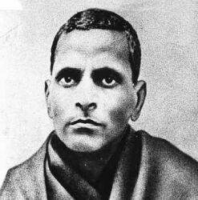
Unlike most Northern communities where people identify most strongly with religion and caste, the divisions down south are on lingual lines. Although I previously removed AP from this picture, one will do well to remember Potti Sriramulu (picture below), who born into the Madras Presidency died as a Telugu martyr.


His death reshaped India's map and gave us states based on language. Interestingly enough, there were debates as to whether Madras was to be part of Andhra Pradesh or Tamil Nadu (with C. Rajagopalachari and Nehru, both favouring to keep it in TN) owing to the large communities of Andhrites as well as Tamilians in the city.

When human beings draw careless boundaries on the map, they reshape the future of civilization. Only a few decades after the formation of AP, we have only a small (but often influential) representation of Telugu-speakers in Chennai today. Similarly, Tirupati - where boards in Tamil were ubiquitous - has been cleansed of the Tamil language and replaced by Telugu. Stronger divides still, happen on the national level, as in the case of India and Pakistan, where now the respective scripts are mutually unintelligible. 

What all this tells us is that language, like any other aspect of civilization, requires patronage and support in order to exist. The invisible hand of market forces can hardly stand up to the real force of political will. In such a scenario, it makes perfect sense to protect a language and preserve heritage. Reactionary steps are only to be expected when the Government of the land tries to propagate one of its languages preferentially, albeit not necessarily at the expense of another. But we are talking about identity here, and there are few things that come with higher stakes.

The Modern Notion of India:

Sometimes, I am perturbed by the fact that restaurants in Delhi have on their boards messages such as:

"Cuisines: Indian, South Indian, Chinese". The definition of 'India' then begins to confuse me. Is South India a sub-set of India (as would seem logical) or is it another part of a vast region, thoroughly separated, united only by national elections?

Even today, I am asked - "Why do your people not speak Hindi? It is the mother tongue of the majority of India!" To clarify things at this point, I speak Hindi and Tamil, although I can write only in the former, much to my chagrin. My parents, brought up in 20th Century India, decided that it was better for me to learn the language spoken by the majority first, before my own mother tongue. While all that is water under the bridge, this only helps me consolidate my point that the people of Tamil Nadu are not opposed to Hindi as a language.

However, we expect our guests to speak in Tamil (or at least feign to learn) when they are visiting us, just the way we learn Hindi when we visit them. To say that Hindi is more Indian than Tamil is, or the even more inane "Hindi is the national language", is a poor line for apatriot to take. I am reminded of a vivid quote made by C. N. Annadurai - "It is claimed that Hindi should be the common language because it is spoken by the majority. Why should we then claim the tiger as our national animal instead of the rat which is so much more numerous? Or the peocock as our national bird when the crow is ubiquitous?"

It must also be noted here that Hindi and English are both, to some extent, foreign languages in the southern tip of the peninsula. The fact that enterprising Malabaris have picked up the languages quickly and become trilingual (I am assuming not all Malabaris can speak Arabic also) is something they should be credited with, and this is not something one can hold against people who haven't become multilingual with such rapidity.

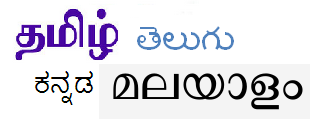
While the question of whether a person from Region C should be encouraged, or perhaps forced, to speak in Hindi is widely debated, the more basic question regarding whether an outsider should be asked to learn the tongue-of-the-land is being left unattended. When I first went to Roorkee (which lies in the state of Uttarakhand), I was appalled to find out that people couldn't match the southern states with their respective languages. In fact, even today, I'm fairly confident that few will be able to tell which language is which from among the following:

So, another thing that the imposition of Hindi by the state does is promote one-upmanship, and let citizens take it for granted that Hindi is more important than any other language in India. In fact, prominent books written in the twenty-first century use those very words - "Hindi is the most important language in the country". Such statements beg the question: "Does Indian-ness have its roots in Hindi?"

Is it wrong for an auto-wallah in TN (who probably doesn't know Hindi) to speak in Tamil to a Hindi-speaker, while it is right for the Prime Minister (who clearly knows English) to converse in Hindi alone with a non-Hindi speaker? Why is the promotion of a state-language any different from the promotion of a state-religion? Why is only one of these considered taboo?

Second Language and The Future:

Because most higher-learning in this world is being transmitted through the medium of English, it will be difficult, if not impossible, to reject the language altogether. Unless the state can magically conjure a similar infrastructure in Hindi, as there exists in English, it will be wrong to ask people of the southern states to choose Hindi over English, as their second language.

For all practical purposes, this would imply that quarter of a billion people become trilingual at least, to ensure a smooth transition. Learning languages isn't an easy task, especially when the languages belong to entirely different families. This is another reason why Gujaratis, Marwadis and even Maharashtrians can understand Hindi more easily than Tamilians. Similar scripts and shared roots are a great advantage while learning new tongues.

Contrary to a popular misconception, Tamil does not have its roots in Sanskrit. The other three languages have different proportions of Tamil and Sanskrit, as they evolved over the millenniums, gradually developing a flavour of their own. Kannada and Telugu especially, have incorporated far more Sanskrit, and are therefore slightly closer to the northern stream of languages.

All this makes it difficult, both in terms of learning and in terms of ideological acceptance, for Hindi to become a widely accepted second-language in the south, especially in Tamil Nadu. It is possible that, over time, there will be organic growth of the language (this is actually highly probable due to the one-sided language transfer within the country) and that is the only acceptable solution.

Until then, we don't need any more link languages. And thank you very much, we're well-integrated into mother India. We certainly don't need anyone to tell us how we can be better Indians.