Philosophy

On Failure

1. The sheet that covers her face, clenched tightly between her teeth, growing moist around her mouth, is insufficient defence. She twists on the hard mattress, conscious of another morning that attacks her through the gap in the curtain. Another bloody day. Determined to return to sleep, she perceives her own condition from the bedroom door - such drama, such comedy, it is almost unreal. There is nothing left to live for. What's the point anyway?

2. He goes back to the cigarette every time the task is too big. He has been falling off the pace for a few months now. It is incredible how a few bad months can completely derail your life. Money, love and ambition have all dried up; as he stubs the flaming stub under his dusty chappal, he realizes health will soon follow suit. What's the point anyway?

3. You got fired. So what? She left you for another man. So what? Your dreams are crashing and burning in a blinding flame that lights up your wonderful past. So what? You deserted your parents, and now they're dead. How did it all come to this? There is either pain, or nothing. You want neither. Is happiness so difficult to find? Okay, cut that crap about not having to seek happiness. Of course you must seek happiness. Or perish in the attempt. What's the point of life anyway?

4. You cannot lose everything that matters unless you let something matter. You look at your friends, leading their sedentary lives, "hedging risks", existing but never living. Nothing matters. They eat, they breathe, they sleep, they find someone who will share their bed for sixty years, they get themselves a career, they eat, they breathe, they sleep, they defecate... They'll probably never feel like killing themselves. But they'll never feel like Alexander. Go big or go home. Only, "go home" is a lie. You don't go home. You nearly die.

5. You know those flirts? Who don't truly follow their hearts. Because they're cowards. And dabble with millions of ideas, people and events. They'll never make up their minds. Making up their minds would kill them. You know why? Because they'd be All In. Most humans cannot go All In. They're scared. They'd much rather live their lukewarm romances.

6. When you invest blood, sweat and tears in a person, in a book, in a company, in an idea... you do it with expectations. Sri Krishna talks about outcome-independence. Don't bother about the fruits of your actions; your actions are both the means and the end. But who is so great that he/she truly believes this? And if someone truly believes in outcome-independence, doesn't that spell the end of passion? There is no way to reconcile passion and wisdom. No, you cannot have the whole fucking lot.

7. You know it is reasonable to settle into a rhythm, right? Why work outside your comfort-zone? What's that again - "Life starts outside the comfort zone"? Yeah, no it doesn't. Life starts when you emerge from the womb, covered in a film of sticky fluid and wail into the world. Life ends when you can wail no more. Everything in between is life. So you lost. Everybody loses. There is no point analysing this.

8. Where do we go now? Where do we go? Isn't it too late to salvage something? It probably is. Then again, life is weird. There are no beginnings, no middles, no ends. It's just a mess. A hopeless tangle of events, thoughts, emotions, places, people... None of it is supposed to make sense. Not from up close, anyway. Maybe from a distance. From far, far away, everything makes sense. You're living a goddamned epic!

9. And she does it over and over again. She calls me to tell me how she suffers only because of her goodness. Yes doll, you suffer only because of you're good. And successful people are successful only because they have rotten hearts. Get over yourself. If you're good, you wouldn't use it as defence! Goodness needs no incentive. Be good because you want to be good; nobody is asking you to be anything. People are shit? Well, of course they are! If everybody was good, we wouldn't give a damn about you. You angel.

10. "God is a dick!" Well, you believe in God; you haven't been broken enough. Be thankful. And shut up. You know the sequence: believer becomes agnostic, agnostic turns atheist, atheist converts into a bitter cynic, and the bitter cynic suffers real physical pain. Then everybody dies, of course. You know what? You are so conscious about your failure only because you think you can experience the state of not-failing. That's called hope. And hope is a good thing.

World Peace 101

EXTENT

If the extent of the human being – not only in terms of physical dimensions, but also in philosophical scope – is determined and agreed-upon, the world’s problems will no longer exist. The loose definition of the individual’s jurisdiction, open to interpretation and debate, splits us into liberals and conservatives, jihadis and atheists, capitalists and socialists, cow-protectors and beef-eaters, haves and have-nots.

All issues are first fought in the mind, and then in the physical world. Laws govern what we, as individuals, are allowed to control and what we aren't. Citizens who have problems with existing laws campaign for reforms - this is the constitutional route - or work outside the purview of the law. What the individual perceives as his or her jurisdiction ultimately shapes all major debates in the world today.

The niche Western twin-solutions – liberalism and individualism – oversimplify the debate, but give us the most conventionally accepted definition of the individual’s jurisdiction.

OWNERSHIP

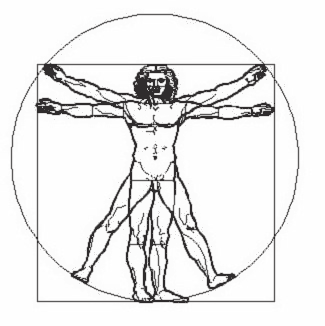
If it is agreed that the human being extends from the toes up to the head, and from the back up to the tips of the fingers, then rights and duties can be determined for this definition of the individual. Laws can be tailored to suit this requirement; any violation of the human body could then be termed a crime. If you get mugged at the street-corner, your personal space has been violated; this is a crime. Similarly, rape is a crime as it is forcible encroachment of personal space. Murder is then the highest crime possible under this system, as it deprives the body of life itself.

The individual’s limit can be extended, with some difficulty, to human-possessions as well. This would then cover issues such as theft, arson and cross-border infiltration. The complications in this extrapolation arise out of the concept of shared ownership. Does a house belong to the tenant or the owner? Do you – the owner – have a right to determine who is and who isn’t allowed into the house? Is it reasonable to enforce a No Smoking policy in the house, even though you – the owner – don’t currently live there? If you are a vegetarian opposed to animal slaughter, is it reasonable to ask your tenant to refrain from cooking meat in the kitchen?

Marriage can be seen as a contract wherein two individuals devolve certain strictly private rights in order to gain other rights over each other. Again, we ask ourselves: “Where do I end? Where do you begin?” We struggle to define these boundaries with children as well, because they are inseparable from the parents. Is it a good thing if a child is being forced to do his or her homework? At what age do we start respecting the child’s liberty? This is only the tip of a vast grey-zone, which even individualism and liberalism – which have worked well so far – struggle to pierce.

COMMUNITY

Drawing the boundaries with greater precision or defining rules with firmer bases do not help in tackling this grey jurisdiction. No matter how well you draw these lines, there will always be conflict. There will be conflict even if everybody agrees with a common definition of the limits of a human being.

Because an individual is created by a community, and a community, in turn, is created by a cluster of individuals, it is impossible to separate them from one-another. The society as a whole often carries powerful opinions, and these deserve certain respect. A blind shift towards individuality disrupts a system of shared communal-values. The individual's struggle against societal values must be acknowledged; it must not be opposed. But it also should not be glorified.

““I disapprove of what you say, but I will defend to the death your right to say it”.”
— "The Friends of Voltaire", Evelyn Beatrice Hall [1906]

IDEAS

In the light of Charlie Hebdo and the rise of Islamism, it has often been said that people have rights, but ideas do not have rights. Saying this repeatedly does not bring us any closer to a planet where this is true. Much has been said about the contagious nature of ideas, how they are bulletproof, how they cannot be destroyed by bombs and bullets… All these sayings are, interestingly, said about ideas which are considered positive. They are nevertheless true for all kinds of ideas. Shooting Parisians does destroy the idea of liberté-égalité-fraternité.  Similarly, bombing ISIS does not destroy the idea of a Caliphate.

The earlier quote (by Evelyn Beatrice Hall) about the Freedom of Speech and Expression is an important step towards liberty, but it takes a myopic view of society. In fact, it fails to consider the Idea as a serious force - more serious, perhaps, than the individual. This is because the idea does not ever exist alone, independent of actions and feelings. By denying the idea certain intrinsic rights, and by simply disapproving it and letting it be, we only create a more confusing, agitated world.

Ideas are shared possessions of humanity. The concepts we use to deal with them are far too limited in their scope, and thus yield statements such as “ideas do not have rights”. Of course, ideas have rights! The moment such a statement is made, it becomes true. We can choose not to acknowledge them, at our own peril.

Ideas usually lie in this grey-zone; they are neither mine nor yours. Yet, we expect one of them to be more correct than the other. Terrorism is an idea, counter-terrorism is another. Capitalism is an idea, communism is another. Science is an idea, not-Science is another. One of these sides can gain temporary ground over another; that is all what such a victory will ever be: temporary.

CONFLICT

It does not matter how strongly you believe in Science or, for that matter, Allah. There will be another side that does not agree. At this point, we have a choice. First choice: we can draw idea-borders (we can disapprove of each other), march to the frontlines and train our weapons at people on the other side. This is what we have been historically doing. According to modern sensibility, ideological wars are wonderful as long as there is no physical violation of another’s space. Since ideas do not have rights, it is perfectly acceptable (and sometimes, glorified) to decimate them. This, however, does little to settle a conflict. This constant violation of the individual’s space – in a realm that is abstract, but very real – is left unacknowledged until a physical action takes place.

The other choice is to create a world of shared possessions. Everything belongs to everyone, with varying degrees of influence. Boundaries, if they must exist, need to be fluid. In such a world, ideas can be acknowledged. Dialogue will not mean debate. Different viewpoints will coexist; the urge to unite viewpoints will give way to the urge to understand differences.

Not only will we allow for the existence of foreign ideas, but we will also understand them. We will respect ideas for being what they are: ideas. “So you believe that God created our world over seven days? I think we evolved from a Spaghetti monster. What do you think about that?”

The definition of the individual needs to be extended and softened. The world could then be a better place.

On Writing

The Beginning

I started writing a long time ago; I don't remember when. The past, so often, gets crushed together making space for a massive present, until the difference between yesterday and today is as significant as that between 2010 and 2011. However, I remember I started writing fantasy.

My first story was an amalgamation of the Smurfs and the Mahabharata. Much later, after I read my first Potter book, the same work included a Hogwarts-esque world as well. In fact, for the best part of a year, I was hell-bent on improving J.K. Rowling's literature; it didn't live up to my expectations, and in a mad childish whim, I tried to do better. My protagonist - shamelessly given a European name 'Peter' and white skin - thus journeyed into a terrifying world through a nightmare.

Over time, I imagine my writing developed a slight flavour, as I experimented with Indian myth; most prominently with a Bheema-like figure called 'Veera'. What I read - mostly European and American fiction - still shaped my works strongly. I never completed any of these tales. They held my attention for a while, and during this period, I was devoted to them; then they slipped away.

The Steadfast Tin Soldier?

Ashwin's story began as a blog-post that became longer than anticipated. I promised myself it would end as a 10,000-word short-story; I later found it transforming into a novella, and finally into a 70,000-word novel. I never wished to publish the work. But when the story ended, leaving me friendless for a short while, I decided - why not?

'The Steadfast Tin Soldier?' is not as autobiographical as people say it is, but it isn't independent of its author. I put a considerable portion of myself into that book, and sold it to the market. At first, it felt strange that something as intensely personal as a story was being read by other people. Soon, like many others before me, I learned to distance myself from the tale. In a strange way, imagination shaped reality.

My first foray into a longer form of writing was thoroughly satisfying. I was happy inside that bubble of imagination, untroubled by the world outside. I could live the life of Ashwin - my protagonist - and struggle his struggles, but in a world created by me. So the struggles always had purpose; I found purpose through writing.

MR19

Here, I write about the book I never got published. Not yet, anyway. MR19 - which only my closest friends have read - is the story of a man who tries to understand the world as it changes. The story, a work in mythology and science-fiction, happens in the future - in a homogenized planet. I wrote MR19 in order to understand the world, to accept the changing zeitgeist. I found enlightenment in writing.

Writing is more about listening to a story, than about telling one. I imagine that I write better than I converse; that is only because, when I write, I am listening to the story alongside you. The story plays out with a mind of its own. I cannot begin to describe - this paradox is unintentional - the beauty of a scene unravelling itself to you for the first time.

Nobody Remembers Ram

I wrote my latest book in two months. I was possessed by the story; it did not let me sleep. I wrote from bed, at work, in the metro, at bars, in coffee-shops, when I was friends, when I was on a family-vacation, in trains, inside planes, while eating... I found peace in writing.

This is a story of a successful man who goes missing. People search for him. They discover a narrative of his experiences. By elevating the pleasures and torments of a fictional character, I have been able to placate my own self.

There is too much turbulence in the world outside. Frankly, I don't care much about people and places any more. Why should I be part of something I cannot control? Give me a paper and a pen.