Work

Understanding Why "Time Flies" In 2020

Saturday morning coffee is a mental marker. Like post-it notes stuck on the Calendar, at equal intervals, every week on Saturday - at approximately 10.30 am each day. Every time I sip this coffee, I'm reminded of the events of the week that went by. So I count weeks like this, coffee to coffee, every Saturday.

Ever since the lock-down began, I realize I'm sipping Saturday coffees in quick succession. And since Saturday coffees can be had only on Saturdays, I can only conclude that Saturdays are coming and going faster than they used to in the past.


I've asked family and friends if they feel this way too, to identify if this is a feeling that is solely mine or if it is shared by members of the community. I've been told that many people share this feeling: time flies in 2020.

I don't love this year any more than the last, but it hasn't given me any reason to dislike it either. So, I don't particularly wish to alter my perception of the speed of time now; I wouldn't really care if it moved any faster or slower. I do, however, wish to understand why our shared experience tells us now that time is flying past.

One significant shift in our behaviour during the pandemic is the abandonment or lack of focused, time-bound pursuit of medium-term goals. Most immediate goals (eating, sleeping, tomorrow's deadline for work, shopping for groceries, etc) haven't changed, and they are repetitive; neither have the long-term goals (career progress goals, family goals, monetary goals, etc).

But the medium term is hazier than before. When is our next vacation? Do we plan to buy a new house in the next 4-6 months? A new car? Can we go out for a movie this month? Many of these goals fall into the "want" bucket, as opposed to the "need" bucket. And in the face of ambiguity created by COVID-19, we have sacrificed these goals.

The presence of immediate, repetitive, short-term goals and absence of medium-term objectives present us with a strange situation: the present seems to be in a loop, and there are fewer things to look-forward to. We can no longer get through a monotonous week eagerly anticipating a weekend movie, or work through the month while planning the upcoming international trip. We are relegated to working on what is important here and now, in this present moment; future-plans are a lot less tangible than they used to be before the pandemic.

Therefore, we are limited to counting time by our Saturday morning coffees. The anticipation and longing for a future to come sooner was possibly what made us think time wasn't moving fast enough. Today, that longing for a medium-term future is less intense, and the clock is ticking on faster than we would "expect".

The writing of this post sufficiently slowed down time for me. I realize that variety of experience and  a stubborn belief in a definite medium-term future is important to balance my perception of time.
Coronavirus and the new Work-Paradigm


Many of us will realize that we're not suited for #remotework and remote meetings. And this can cause a major work-paradigm-shift. Here's why:

(1) The conversion funnel (Written notes -> Phone Calls -> Video Calls -> In-person meetings) has changed overnight. The penultimate step must now convert. #conversion

(2) This is more difficult in low-trust settings than in high-trust ones. Low-trust environments tend to place a lot of emphasis on the face-to-face meeting. In this context, India will be more affected than the US if the #coronavirus situation persists.

(3) Non-verbal communication skills - both sending and receiving - are slightly different for in-person and virtual interactions. People with a head-start in remote-work will do better in the short-run.

(4) Virtual meetings can leave you with the feeling of less control. Slightly better than a phone-call, but significantly lesser than being on the same table. #virtualmeetings

(5) The remote work environment requires teams to be more planned and coordinated than ever before. Teams not using work management tools effectively will perish to competition. Planners will win.

(6) Patience: the new work paradigm will require one to be more patient and trusting than ever before. Tone needs to be more neutral. The same emotional conversation online and offline can leave people with very different messages [at least in the short term].

(7) Distractions are everywhere. Physical separation from comfort environment no longer possible; requires much more self-control. People will start using more Internet Time Management tools?

(8) The superstars of yesterday and those of tomorrow will require very different attributes. As always, those who adapt faster will survive.

Men at Work

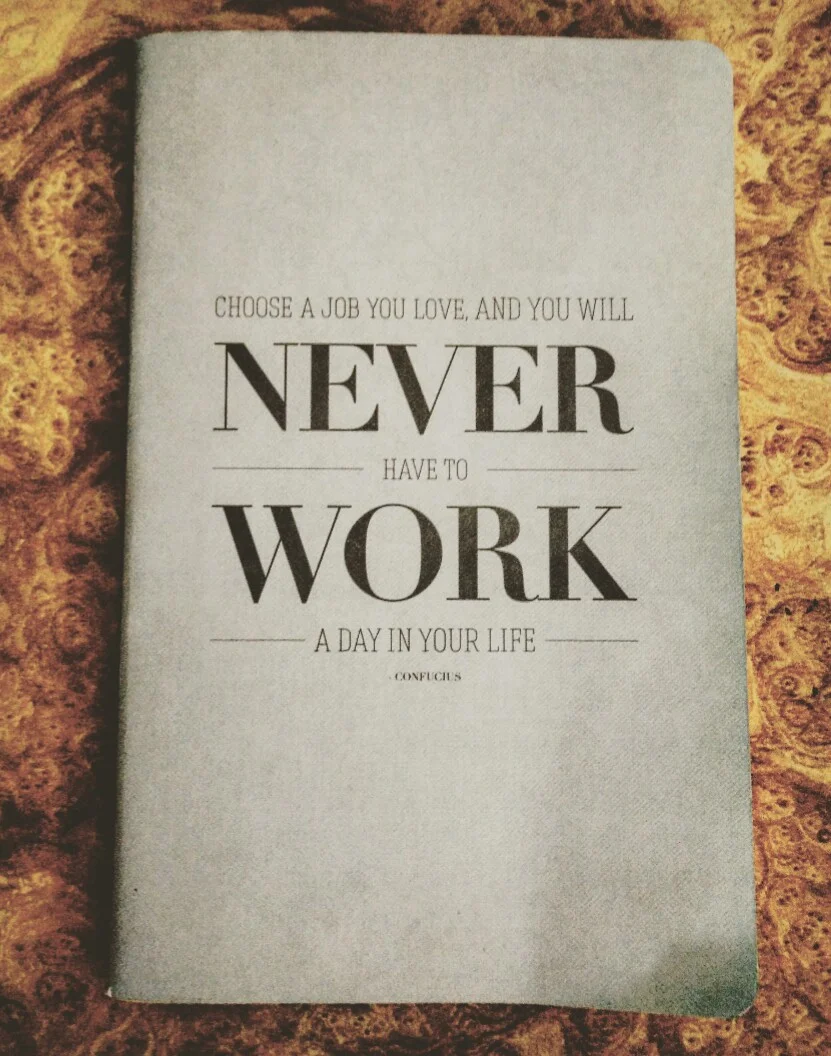
When I began this exciting new project - which I had no idea about at the time, my friends gifted me a notebook and a fountain pen. While fountain pens are delightful as long as you don't turn them into actual ink-fountains, it was the notebook that held my attention for the longest time. Its cover:

I'm writing again now, my third full-length novel. I'm starting a Sports-Tech company. (I will talk about these, in detail, some other time.) But both artistic and entrepreneurial pursuits have one thing in common: work-definition. There are, in fact, two reasons why you don't feel like it is work.

One popular understanding of 'work' is that it is something you don't enjoy very much - something you provide so as to earn a monthly salary. I think the notebook talks about this idea of work. By this definition, of course, you don't work when you're enjoying yourself.

The more interesting part about creative pursuits, however, is the idea of creating tasks. Nothing exists until you first put it there. And when you define tasks, you are not only defining inputs and processes, you are also trying to understand the possible outputs - how to measure it, do they follow a pattern, are they as expected, are they in line with inputs?

When I still had an engineering-management job, tasks had zeros and ones. There was a process to go from zero to one. When you finished a task, you marked it 'done'. As opposed to this, I now had a burgeoning number of unfinished tasks; I am not quite sure what is the beginning, what is the end. Discrete states - beginning and end - have been replaced by a slope; it goes on and on, perhaps to places I haven't even dreamed about.

I have an idea. I don't know how I will get there. I can only believe I will get there somehow. I can only be sure of my effort.