Hinduism

The Idea of India - Sunil Khilnani [Book Review]

I finished reading Sunil Khilnani's book "The Idea of India" yesterday, although I felt there was scope for it to be renamed by prefacing the title with the word "Defending", and adding "Nehruvian" after the definite article.

In fact, I'd suggest a renaming of the chapters to succinctly capture their intent and message:

Chapter 1: Democracy A Portrait of Nehru as the Father of the Nation

Chapter 2: Temples of the Future How India's Economy Went bust

Chapter 3: Cities Erasing all of India's pasts to force Indians into Modernity

Chapter 4: Who is an Indian?  India is not Hindu.

As one would expect given the author's stature, the book is incredibly articulate and "combative" (in Amartya Sen's words) albeit ideologically narrow. It is a classic work from the liberal school which believes it is protecting everything by suffocating all individual things. I quote the author here:

Just at the English language placed all Indians, at least in principle, at a disadvantage of equal unfamiliarity, so, too Chandigarh could not be seized or possessed by any one group.

Throughout the book, one gets the sense that this ideological censor that the Nehruvian idea places on the citizens of this country (which the author seems to accept as essential) is what holds India together. Without it, there would be only anarchy and bloodlust, and a brutal suppression of human rights. But no evidence is provided to support such a flimsy theory.

In fact, the author contrasts India's abysmal average 3% annual growth (between 1950 and 1991) against the rapid advancement of the Asian Tigers - China, Japan, South Korea and Taiwan. That post-independence India's social, economic and political structures may be in disagreement with the needs of its people causing this slothfulness comes up momentarily, but the author is quick to pour cold water on any alternative ideas of India that may help aid the emancipation of the masses. "Liberal" democracy (of the colonial tradition) at all costs, with the state performing a missionary-like role of a societal reformer, is the only solution offered. Hundreds of millions of Indians have the wrong world view, a handful of experts have got it right.

The author however succeeds in painting a picture of the 1950s India in which Nehru found validation in the theories of expert economists like Mahalanobis, and tried to centrally plan India's growth - by making heavy industries and defence public sector undertakings, tightly controlling imports and exports, and regulating free-market capitalism in select sectors through a licence-raj. He also shows the limitations of the Congress in driving change at the local levels, and the futile history of land reforms in India. Later in the Indira Gandhi period, appeasement politics further drains India's money reserves, leaving it on the brink of bankruptcy in 1991. Apart from jokingly citing the disparaging phrase "Hindu rate of growth" as a cause of India's crawling development, the author refuses to put our leaders' erstwhile policies under further scrutiny. Instead, he moves on to speak about India's history and culture.

In this part, it is interesting how the author skips the Islamic period of Indian history completely while bringing out the three main "wrongs" in modern India: one from the pre-Islamic Hindu period - Caste; another created by colonialism - the great rift between urban and rural India; and the final one from post-Independence India - Hindu nationalism or Hindutva. The word "proselytization" doesn't occur once in the entire book. The author further goes on to explain how Muslims lost trust in India's ability to protect them, which in turn led to the creation of Pakistan. Can India protect Kashmir's muslims, he asks (the exodus of Kashmiri Pandits is not mentioned).

One understands the author's theory as follows: it is the duty of every citizen who identifies with a numerical majority to downplay their cultural distinctiveness and beliefs, and hold them as secondary to Nehru's (Khilnani's) Idea of India. Simultaneously, it is the right of all individuals who identify with a numerical minority of any kind to assert themselves and their cultural distinctiveness, so that the state can be perceived as pluralistic. And both these principles are embedded in the paternalistic attitude of a state that thinks it knows best.

This book could only have been written by someone of Indian (more specifically, Hindu elite) origin who is thoroughly educated in the western tradition, until those are the only filters through which their mind processes reality. 

The author is therefore able to assume the position of the "real Indian", re-describing processes and events until it supports their ideal of the world. Further, the position assumed by the author enables him to think of the "other" (SCs, Dalits, Muslims, Christians) like a saviour; it is precisely this position that allows the author to rationalize all actions, including acts of violent extremism, of the "other", and condemn majority Hindus whenever any self-assertion begins, an intellectual self-flagellation.

The book in its entirety is a masterpiece of intellectual colonialism. It is limited in its understanding of democracy (anything against the author's views is called "majoritarianism"), and of liberty (as it is only a specific type of freedom that the author supports). In some ways, it is similar to what James Mill may have written about India if he was living in 1998.

Mill's History of British India begins with a remarkable preface. He says that his never having been to India and knowing none of the native languages are an advantage, and a guarantee of his objectivity. But, far from being objective, his is, as he says, a 'critical, or judging history' whose judgements on Hindu customs and practices are particularly harsh. He denounces their 'rude' and 'backward' culture for its ignorance, superstition, and mistreatment of women, and leaves no doubt that he favours a thoroughgoing reform of Indian institutions and practices.

The few constructive points of the book are empirical, not ideological, in nature. India's transition from the first two decades after independence into the emergency under Indira Gandhi, and later into the caste- and regional- politics on the 80s and 90s is well brought out. The aspirations and limitations of the leaders at various points are also explained. In fact, the book has much to offer in terms of political and economic analysis, but sadly chooses to approach every aspect through a narrow ideological framework.

I understand that the book was written a few years after the Babri Masjid demolition, and the author may have intended this book as a rebuttal of certain ideas that were capturing Indian minds. But he goes to the extent of saying that "to Hindu nationalists, Ayodhya has telescoped into a single narrative otherwise unrelated events: the birth of Ram 9,00,000 years ago, the entry of the Mughals into India in 1526, and the rise of the BJP to correct wrongs of the past..." In 1998, there was no Supreme Court judgement on the Ram Mandir, but to say that there was no original temple in Ayodhya that was destroyed with so much conviction points to the fundamental dangers of the author's ideology.

I'd like to summarize the book in two lines: This is the author's limited understanding of India, that does little to help the reader understand the process or prepare a way forward into the future. It is a narrative of India that is confused, helpless and ashamed of itself.  

A Deepavali Without Crackers

14th November 2001: As the first rays of the sun cut through the long shadows of the trees outside our apartment, my brother shook me awake. "It's Deepavali!"


We jumped out of bed, rushed to the hall, where the elders were already drinking their morning tea, listening to Venkateshwara Suprabhatam. Ammamma applied a few drops of sesame oil on our foreheads. A squabble ensued: who would be the first to take a morning bath? Whoever won would gain a definitive head-start: they would get their new clothes first, get to have the first bites of the sweets, and most importantly, they would gain access to that white plastic bag half-full with crackers.

I don't remember who won, but I do remember rushing to the pooja room, completing my morning prayers and putting on a crisply ironed white T-Shirt with kumkum on the insides of the collar. I recall quickly munching on some murukku and ladoos after the neivedhyam, before rushing downstairs to be the first kids on the block to get the fireworks going.

I disliked the loud atom bombs, but liked the bijlis, flowerpots, and chakras. The entire family soon joined us downstairs, like they did every year, as we lit a candle behind a pillar in the parking lot (which served as an undying flame where we would light our sparklers, matches and agarbathis which were used to light the crackers). Soon the whole building gathered, and before you knew it, it was time for lunch!


We spent the rest of the day meeting relatives and neighbours, sharing sweets and good wishes, doing a lot of phone calls, while the TV went on in the background. In the evening, the sky lit up and when we looked east towards the ocean, we saw - above the lighthouse - myriad colours raining upon the city.

Deepavali has always been the most wonderful day of the year!


Diwali diyas

Fast forward 19 years: 14th November 2020

This is a strange Deepavali. It is also a time to look back and be grateful for having made it this far, not just a time to look forward towards the prosperous days which are to come.

But as always, it is about being thankful for the love and care we receive. It about being with the family under one roof and spending time together. It is about lighting a diya for all those beloved souls who have left us.

It is also a time when Deepavali has been made more materialistic than it has ever been before. It is a time when we wear a kurta long enough to click a few photos that will look good on Instagram. Diwali is now about buying expensive sweets, not making them with family at home (our new lifestyles don't prioritize such activities). Diwali is now about using the promo code FESTIVE40. It is about the newest Snapchat filter, a few intelligent Muhurat Trades on the Bombay Stock Exchange, and a virtuous post about not bursting crackers.

I am now in Delhi where the AQI has been 600+ on many occasions in the past week. We now have two air purifiers at home, and they run 24x7. Breathing this level of particulate matter in the air makes it equivalent to smoking about 30 cigarettes each day. The air in a wise man's words is "filthy".

While the root cause of the problem is the large-scale burning of crops in Punjab and Haryana, Mr. Kejriwal has taken an easier route. He has banned the sale of fire-crackers in Delhi, in a feeble attempt to arrest the deterioration of the capital's air quality. This has obviously enraged several factions of the society. #हम_तो_पटाखे_फोड़ेंगे (We will burst crackers) is trending on Twitter.

While I have personally not burst crackers over the past 4-5 years (with the exception of a box of sparklers that I ritualistically share with neighbours and friends on Deepavali-evening), I find it disturbing that such a restrictive-order has been passed in what, otherwise, is a free market. In that light, I empathize with the popular uproar against such government interference.


Understanding Risk

The most common argument against firecrackers is that they can cause a sudden spike of pollution in the immediate vicinity of the firecrackers for a short period of time. Each cracker is a point-source of pollution which can raise the particulate matter level in your immediate vicinity a thousand times for a few minutes.

This can make the air more harmful to breathe especially for the people in the immediate proximity of cracker bursting (including those who are lighting the wick), and therefore firecrackers need regulation. In a way, this is similar to protecting people from the harms of eating fast-food. While we understand that obesity is a risk, we don’t ban restaurants that serve burgers.

Risk is always assessed as a trade-off. There are gains and losses, and one can draw a line where the losses outweigh the gains and vice-versa. Vehicles on the road cause millions of roadside fatalities each year, but we do not ban transportation or driving. Instead, we set speed limits and mandate that passengers wear seat-belts.

When a government bans or censors any action or speech (or thought), it should be a result of a thorough assessment of risk and understanding all the preventive and mitigative options at hand. The last-minute firecracker-ban in our case is simply a result of lazy policy-making where officials simply haven’t done their homework.

There are always alternative options: (a) to regulate the types of firecrackers, and promote only the bursting of “green crackers”, (b) to control the number and size of firecrackers allowed to be purchased from stores, (c) to centrally create Diwali experiences, where people of a locality can gather and observe the festivities together (like on the fourth of July in the US), or (d) regulate the time and place where fire-crackers are allowed to be burst in a city.

It is also important for policy “experts” to understand the people, just as it is for people to understand the experts. And I will elaborate on this in the coming sections.

Traditions without Meaning

We are an ancient civilization with a certain thread of continuity that takes us back at least five thousand years. Traditional Hindus believe in the epistemic authority of the Vedas, accept the existence of Paramātmā, and may pray to several traditional Hindu gods and goddesses. For them, Deepavali is a celebration of Shri Rāma returning to Ayodhya, or of Shri Krishna defeating the demon Narakāsura.

Many modern Hindus who celebrate Deepavali don't fully know (nor do they think it necessary to know) the itihasa that provides us with the reason to celebrate this day. But for them too, it is an important festival to meet and get together with their friends and relatives, to share a few sweets, snacks and laughs.

Even when one dissociates the festival from its scriptural roots (if this is indeed possible), it is clear that the societal importance of Deepavali in modern India cannot be overstated. The rituals associated with the festival are grounded in tradition, passed on from generation to generation, changing albeit gradually over the ages.

If one were to extract the essence of the festival, by removing the layers of historical and cultural meaning it is shrouded in, it is this: Light (of Dharma). Or, as we learnt in our Social Studies text books - "Diwali is the festival of lights".

In an endeavour to foster communal brotherhood, and in the proud tradition of secular policymaking around the world (this is not limited to just India), the euphemism "Festival of Lights" has been found the only acceptable and politically-correct one. It allows for feeble clichés like "good wins over evil", and distances the celebration from its own roots. Lord Rāma himself is vilified, and it is considered immoral in certain circles to celebrate his victory over Rāvana (which is technically the same as celebrating the victory of good over evil).

The same people who decry Shri Rāma may well be found sipping a glass of wine in their latest Fab India kurtis in a South Delhi Diwali party. The festival is therefore ripped out from its religious origins, leaving only a flimsy veneer of traditional Indianness that is allowed to rear its uncomfortable head once or twice a year.

Faith Is The New Shame

In Tier I India, the temple is almost a place of shame. This is true, not only in India, but in most developed economies across the world: to believe is to be backward. Atheists, emboldened by a half-knowledge of Science, are the new alphas.

It is a well-known fact that as a society prospers, its dependence on religion (and dogma) decreases. However, a practicing Hindu in modern India is often made to feel backward, ignorant, and ashamed, often in ways that Christians or Muslims are never made to feel in countries where they are a majority.

History tells us that several Muslim invaders who failed to successfully convert or assimilate with the indigenous people of India went to great lengths to subvert Hindu faith. Of course, not all Mughal emperors were averse to Hindu festivals, but Aurangzeb in particular focused singularly on banning the celebration of Deepavali in 1665.

Our British history which exerts a more powerful influence on modern India than the Mughal-period further restricted the development of our indigenous schools of thought. Missionaries in particular made extraordinary efforts to fuse and adapt Christian faith to Indian ways, making our next generations more in their own mold. Once they owned the way of our thought, they could after all rule (exploit) us better.

These portions of medieval and modern history, coupled with the current cultural dominance of the Western world, exert an almighty influence on the modern Tier I Indian. While the atheist lens has become more popular, it is often viewed (by those who possess these lenses) as the only "correct" lens. Unfortunately, when one is unable to see all points of view, they are usually rushed into thinking that they must be right.

Many people in the position to influence policy and law are limited by this lens. Having been educated to believe that their own particular skeptical, secular perspectives are in the right, they fail to understand the people who their policies affect.

Historically, bursting crackers together in a community is an opportunity to interact, share and connect. I remember this one Deepavali, in 2010, which I spent away from home at a friend’s place in Dehradun. His father had a huge bag of firecrackers, and all the children in the street took turns to burst them. Several neighbours gathered outside the house, and it was a beautiful way to connect with relatives and friends who we don’t see in our daily lives.

Now with a cracker-ban, such spontaneous gatherings shall sadly not happen.

“Wish you a Clean, Noiseless, Safe Diwali”

Hundreds of popular Whatsapp forwards flow into our phones on Deepavali, and many of them contain words such as “safe”, “noiseless”, and “clean”.

Swiss philosopher and linguist, Ferdinand de Saussure put forward a theory which differentiates between the denotation and connotation of a statement. Denotation is the strict dictionary meaning of a word; Connotation is the emotional and imaginative association surrounding a word.

For example, the word “cow” denotes a four-legged bovine, typically with two horns that we are all familiar with. But the connotation of the word “cow” may be different for different people. It may conjure up a mental image of the sacred cow or gau mātā, the divine cow which nourishes our family with her milk; for someone else, “cow” may make them think of a barbecue and its fresh red meat.

In the same way, while the statement “Wish you a clean, noiseless, safe Diwali” denotes something perfectly alright, it is alarming that the wish has very little to do with the spirit of Deepavali and the victory of light (dharma), and everything to do with telling someone else how they should celebrate on that day.

Why “safe”? Was Deepavali unsafe before you wished me thus? And why “noiseless”? Most people not only take the noise of firecrackers on Deepavali in their stride, but they generally enjoy firecrackers.

I often hear someone wishing, "I want clean, noiseless festivals, and I prefer chocolates over Indian ghee-based sweets as they are healthier." They could well cite the exact decibel-level above which we feel uncomfortable, or the number of calories in a besan laddoo vis-à-vis a cube of dark chocolate. Many people who belong to this camp enjoy drinking alcohol on social occasions. But doesn’t alcohol impair our judgement and our physical health? In response to this, people say “I drink in moderation. I know when to stop.”

Such a double-truth is thus maintained by most of us: one nuanced solution for things we truly care about, and another crude zero-or-one kind of solution for things we do not like.

The scientific inquisition that has led to the cracker ban is not true to the scientific spirit. It is ideological in itself.

Why Can't You Plant a Tree for Diwali instead of Bursting Crackers?

A prominent "personality" on social media recently asked this inept question. Of course, it can be countered with a set of equally ridiculous questions such as "Why don't you cut a cake on Eid instead of a goat?" or "Why can't you plant a coniferous tree, instead of cutting one down for Christmas?". But such questions serve no point, as rituals are built over ages, passed on from generation to generation until they gain acceptance from the community.

It is more useful to understand the motivation of the person asking such a question. Across religious groups, it is more common for a supposed insider to ask these questions. This angers the community even more, and in the age of social media, anger empowers the instigator.

The reason for such behaviour is usually one of these two reasons: firstly, in an atheistic world guided only by science, where there is no ideological right or wrong, it is considered beneficial to question everything. Questioning itself is the ultimate good, and answers are not as important. Therefore, it is easy to dispassionately question something that carries huge emotional meaning for another and consider oneself smart. Secondly, building of a new cult always requires distancing oneself from an older one, and pulling away sections of followers. Therefore, questioning one's own roots and virtue-signaling to people who belong to a similar mindset helps one foster one's own identify. In such situations, it is profitable to step on other people's toes.

So, Should you Burst Crackers on Deepavali?

Ideally, the government should regulate what types of crackers may or may not be used. For example, in some states, "green crackers" have been allowed. When effective regulation happens, industry realigns itself to ensure effective supply-demand matching under the new rules.

In terms of Delhi's air quality, a single day of cracker-bursting would have had negligible impact on the AQI which has been in the 600-800 level over the past week. What is required is a sustained year-round effort to improve Delhi's air, water and environment. Kejriwal's move is nothing more than lip-service, and has potentially done more bad than good for the people of Delhi. By banning fire-crackers at the last moment, the poorer sections involved in making these crackers and the shopkeepers and wholesalers who have stocked them are worst hit. Arvind Kejriwal's policies don't seem to favour the Aam Aadmi this time.

I myself have made some rava kesari, and will celebrate the day by going to the temple, meeting a few friends, lighting some lamps and relaxing at home with my wife and our four-month old puppy.

Happy Deepavali! दीपावली की हार्दिक शुभकामनाएं| இனிய தீபாவளி வாழ்த்துக்கள்.


Is India Hindu or Muslim?

Kumbalgarh, Rajasthan: This proud legacy of the Mewar Rajputs - once the stronghold of Maharana Pratap - earned its fame through conflict. The evil Mughal emperor attacked; the noble king defended his people from destruction. Rana Pratap protected his women and children from loot and rape. He perished in the course of this great struggle, but not before enshrining himself forever in Indian folklore.

Srinagar, Kashmir: Here, there is a majestic fort atop a lone hill popularly known as Hari Parbat. According to legend, the mountain is an oversized pebble which was thrown by Goddess Shakti to slay a demon who terrorised the people. Or so the Hindus tell you. According to the Muslims, there is no Hari Parbat; there is only Koh-e-Maran, and a fort that Akbar built.

Patna, Bihar: As India took on Pakistan in a high-octane clash in the 2011 World Cup - the match was happening in Mohali - an entire mohalla was draped in green with Pakistani crescents. People cheered when Sachin fell; they prayed for Misbah to take them home. Neither of those things happened. India won that game.

Ayodhya, Uttar Pradesh: People from all around the country were mobilised with minimal effort to destroy a historic mosque in Ram Janmabhoomi, so that Ram's empire of dharma could be reestablished. Thousands died; the place - even after being split in three parts - remains in dispute.

UNITY IN DIVERSITY

A man was killed for eating beef. The matter has been thoroughly minced by the Media. "India has become intolerant" under Narendra Modi, they say. News articles proclaim that saffron terror is on the rise. "We are a culture of diversity and debate" is our fall-back line. When all else fails, we will repeat this line, like a broken tape recorder, and hope to feel better.

It is untrue that our country is proud of its unity in diversity. That is a line written for fifth grade Social Sciences textbooks. We are a country of peace, but we don't know what diversity means. Since we didn't have to understand diversity all these years, it did not matter. We all lived in our comfortable little niches, interacting with people similar to us, never venturing too far from home.

Diversity necessitates the existence of dissent. One cannot be different if expected to conform to a majority; there will always be a majority, no matter how small the sample-space. There are as many Indias as there are stories in our country. Each narrative gives us a different picture, and each of these is as true (or as false) as the other.

Can Maharana Pratap be elevated to his Godlike status without vilifying the Mughals? Can we simultaneously celebrate Chhatrapati Shivaji and Aurangzeb? How can Ramjanmabhoomi coexist with Babri Masjid, when they debatably occupy the same spatial coordinates? We are often forced to choose narratives, and therefore forced to choose a particular India.

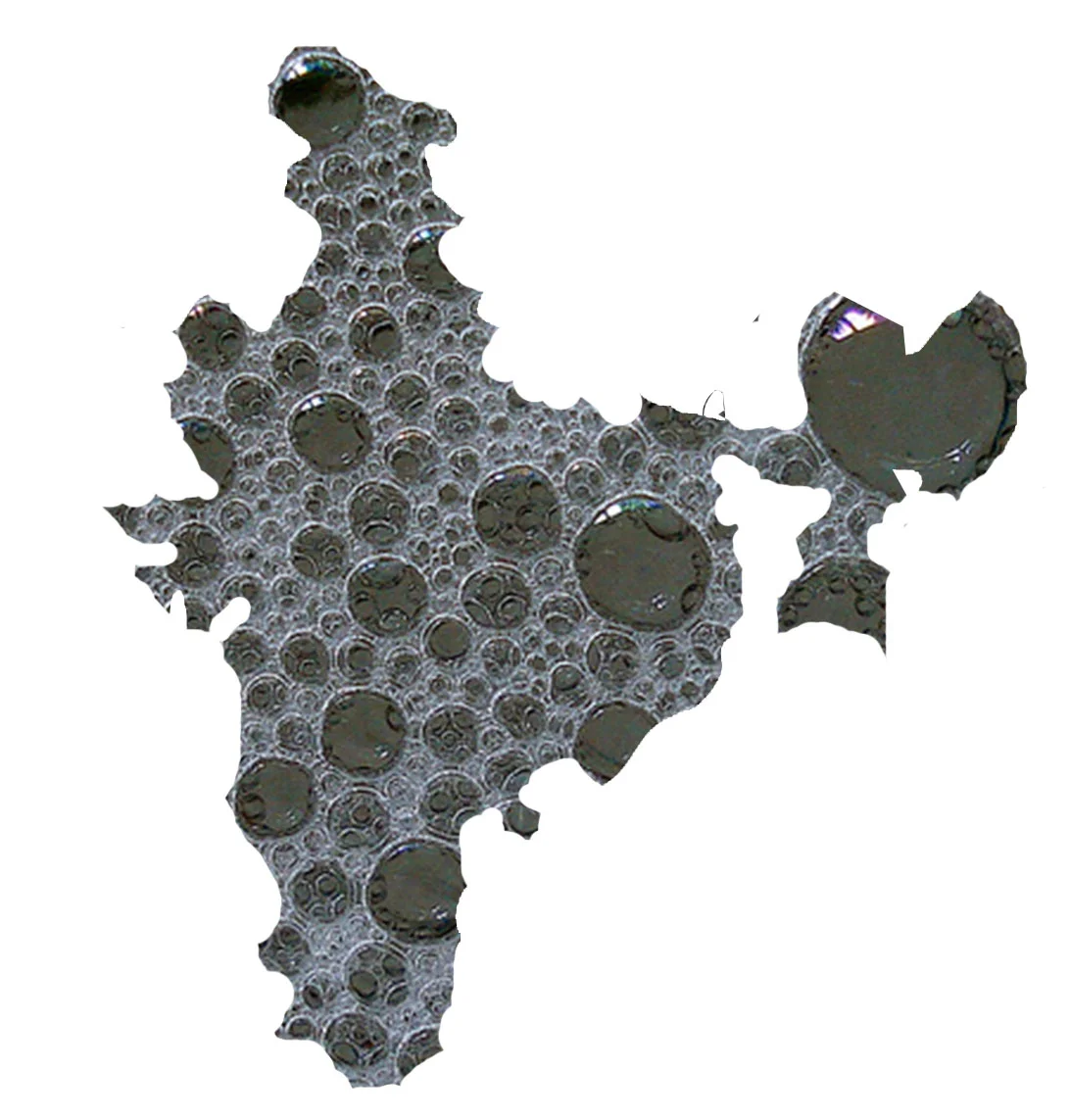
INDIA IS LIKE BUBBLES

We were, until recently, invisible to each other. We all had our little comfortable bubble, which encompassed our world. Everything we needed was within. Faced with globalisation - national integration is a small step in the grander scheme - we are forced to look outside our bubbles.

Of course, it doesn't please us. If it pleased us, we'd have ventured out a long time ago. Over time, some bubbles will coalesce and become super-bubbles. Super-bubbles will throw their weight around, for a while, until there are many such super-bubbles.

Ultimately, there is only one bubble, and that is the world. In my vision of such a mega-super-bubble, it is a place where people thrive on dissimilarities. Our ideas of liberals and conservatives are far too narrow to enter such a world. But I think we will get there.

Citations:

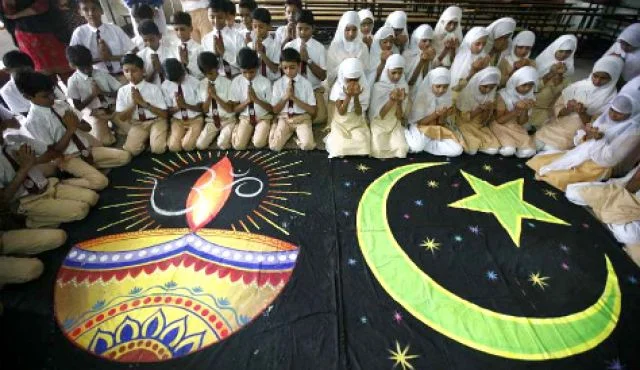
Picture of children praying for peace between Hindus and Muslims in India "http://www.haaretz.com/"